
Physics · Thermal physics · 20 suggested minutes
01 · Heat transfer in the home
Learning objective: Distinguish conduction, convection and radiation.
Heating transfers energy because of a temperature difference. Conduction involves particle interactions within a material, with mobile electrons contributing in metals. Convection is energy transfer by bulk movement of a fluid. Thermal radiation is electromagnetic and does not require a medium. A device can involve several pathways at once.
Temperature is not the same as total internal energy. Internal energy depends on the system’s particles and their kinetic and potential energies. For a substance without a change of state, E = mcΔT gives the thermal energy change when specific heat capacity c is treated as constant. During a change of state, energy can be transferred without a temperature rise.
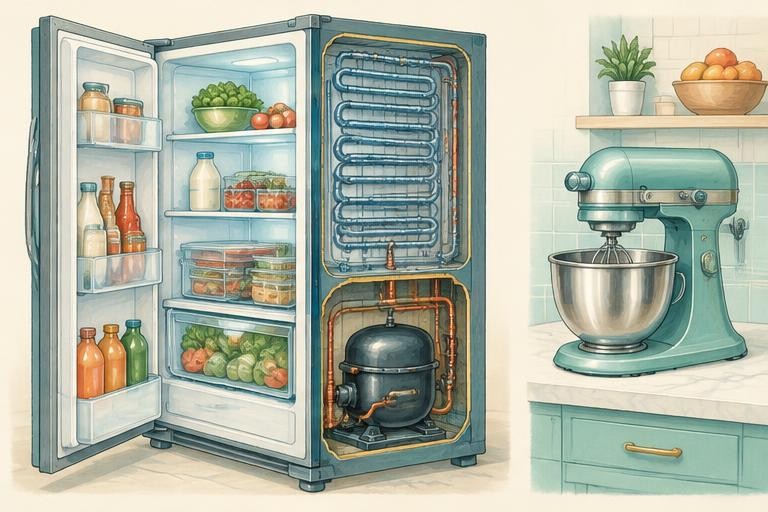
Insulation reduces transfer rates; it does not make all heat transfer disappear. A refrigerator wall, door seal and condenser serve different purposes. Distinguish an ideal classroom model from actual appliance specifications. Never open appliances or touch heating elements to investigate these processes.
Worked example · follow the reasoning
Heating 0.5 kg of water by 10 °C with c = 4200 J/(kg °C) requires E = 0.5 × 4200 × 10 = 21000 J, neglecting container heating and losses.
Common misconception
Cold is not a substance that insulation keeps inside; insulation reduces energy transfer.