
Chemistry · Structure and properties · 20 suggested minutes
01 · Particles, bonding and material properties
Learning objective: Connect structure to properties without treating every property as the same.
A material’s behaviour depends on particles, bonding and larger-scale structure. Metals conduct electricity because mobile electrons can carry charge through the structure. Many ionic substances conduct when molten or dissolved because ions can move, but not as solid crystals where ions are held in place. The identity and arrangement of particles matter.
Conductivity is not strength. Density is mass per volume, stiffness relates to resistance to elastic deformation, strength to resisting failure and toughness to absorbing energy before fracture. A material may perform well in one property and poorly in another. Justify choices using the particular task rather than claiming one material is universally superior.
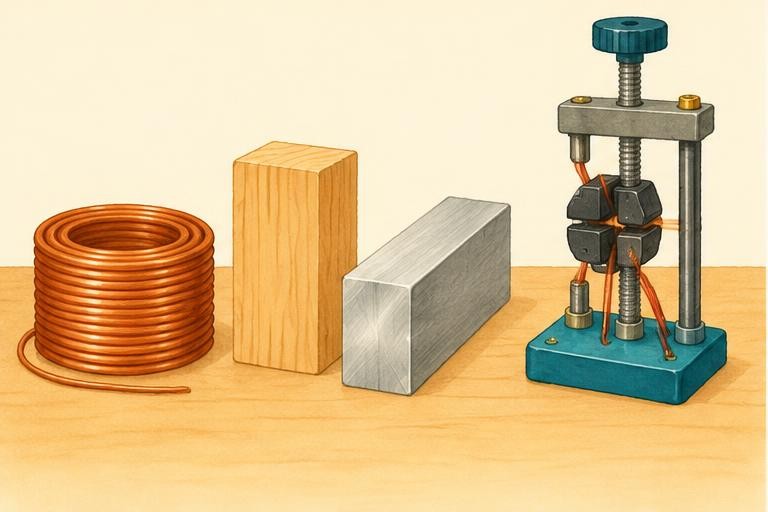
For a wire, an engineer considers conductivity and ability to form a wire, then suitable insulation to reduce unintended contact. For an aircraft part, density, stiffness, strength and fatigue matter. The hall pictures illustrate categories and do not certify the properties or safety ratings of a real sample.
Worked example · follow the reasoning
A 54 g sample occupying 20 cm³ has density 54 / 20 = 2.7 g/cm³. This calculation describes mass per volume, not electrical conductivity or strength.
Common misconception
An electrical insulator can still transfer thermal energy; electrical and thermal conductivity are not identical properties.