
General Electric monogramGE Heritage Village
GE Heritage Village bulb logo

GE STEM Lab · Student course

Trains & Transportation

Trace the power path through a diesel-electric locomotive.

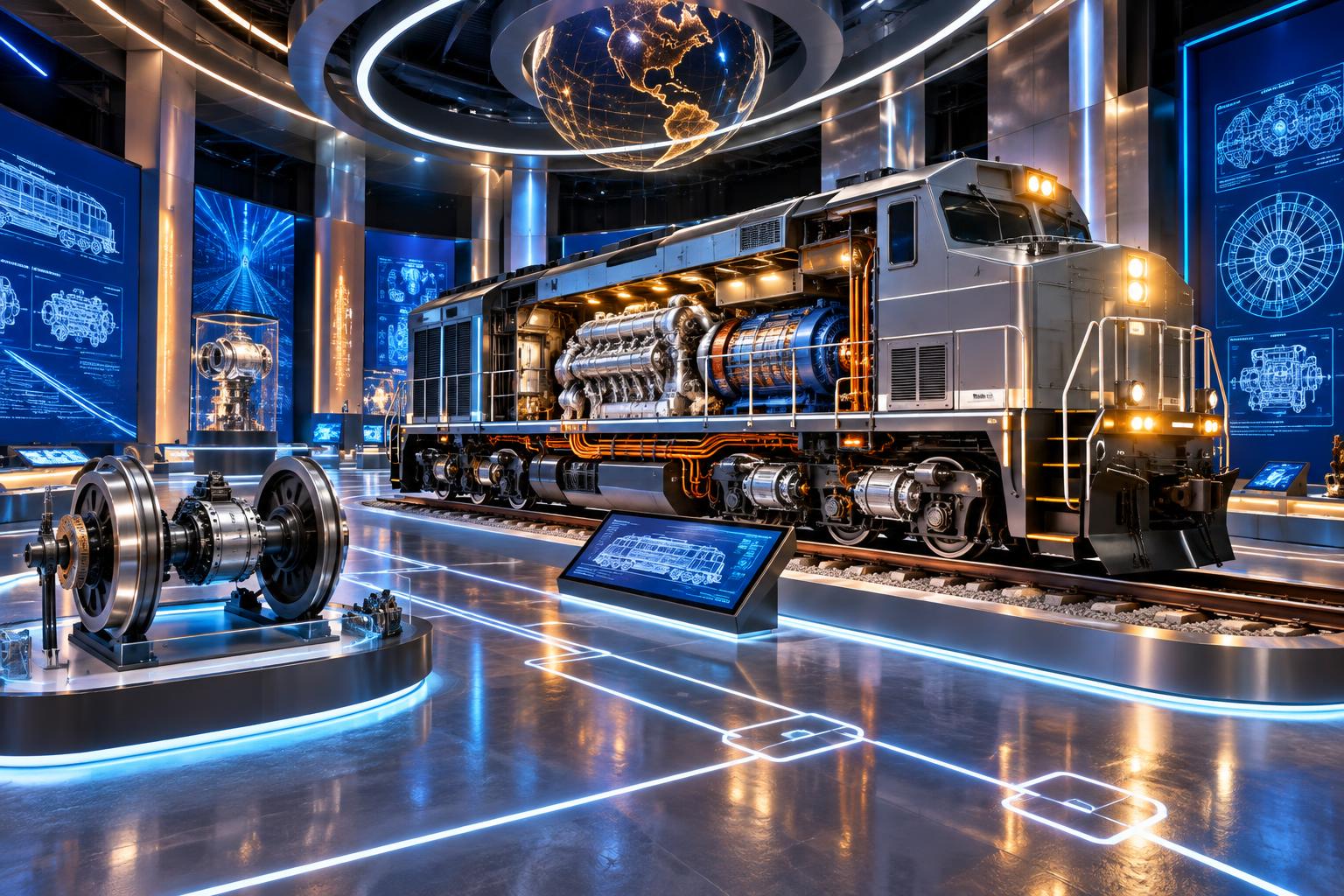
Original imagined learning zone · AI-assisted concept art, not a real GE facility.

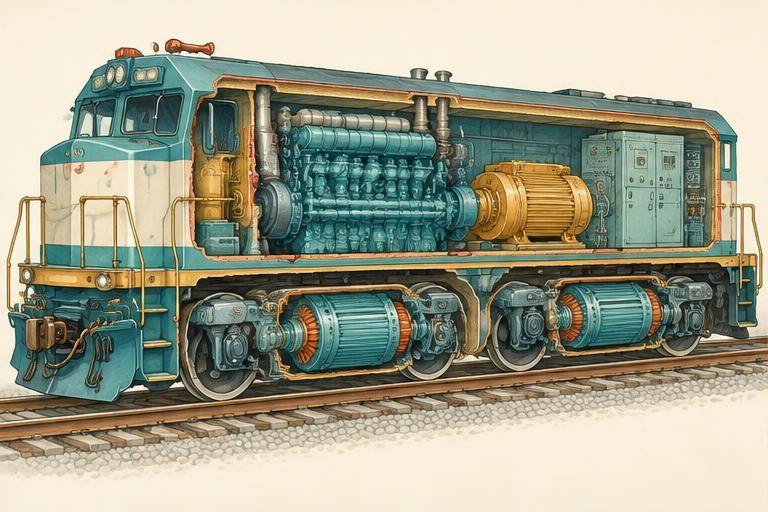
Labeled system diagram · Trains & Transportation
1234Fuel → shaft work → electricity → wheel torque
  1. 1

    Diesel engine

    Transfers energy from fuel combustion into shaft work.

  2. 2

    Generator

    Converts shaft work into electrical energy.

  3. 3

    Traction motor

    Converts electrical energy into wheel-driving torque.

  4. 4

    Wheels & rails

    Contact with the rails provides traction; adhesion limits usable force.

Original simplified teaching schematic—not to scale, an installation guide, a historical artifact or a complete technical blueprint.

🚂 HALL COURSE · 4 COMPLETE LESSONS

Trains & Transportation · learning syllabus

Trace the power path through a diesel-electric locomotive. GE Transportation was spun off and merged with Wabtec in February 2019; this hall covers former-GE transportation heritage.

Suggested 100 minutes · foundation explanations → worked examples → interactive experiments

Physics · Motion · 20 suggested minutes

01 · Motion graphs and Newton’s laws

Learning objective: Relate resultant force, acceleration and velocity graphs.

A train moving at constant velocity has zero resultant force in the simplified straight-line model: traction balances resistance. If traction exceeds resistance, there is a forward resultant and the train accelerates. Newton’s second law is F = ma. Large mass means a given resultant force produces a smaller acceleration.

A velocity–time graph shows how speed and direction change. Gradient gives acceleration; the area gives displacement. Weight and mass differ: mass is measured in kilograms, weight is a gravitational force in newtons. Forces from the rail and resistance processes matter in addition to propulsion.

The virtual traction model subtracts resistance from wheel force; it does not include every real dependence on speed, adhesion or gradient. It is useful for force reasoning but cannot predict a real journey, driving instruction or stopping distance. Never enter railway tracks or working equipment.

Worked example · follow the reasoning

For a fictional 100000 kg train with 30000 N traction and 10000 N resistance, Fnet = 20000 N and a = 0.20 m/s². Constant resistance is a classroom assumption.

Common misconception

A moving train can have balanced forces; force is needed for acceleration, not to prove movement exists.
Physics · Electricity and magnetism; rail enrichment · 25 suggested minutes

02 · Diesel-electric energy conversion

Learning objective: Trace energy from fuel through generation to traction motors.

In a diesel-electric locomotive, the engine transfers chemical energy from fuel into mechanical shaft work. It drives a generator or alternator. Electrical power is controlled and supplied to traction motors, which drive the wheels. Electricity is an intermediate energy-transfer pathway, not a new energy source created by the locomotive.

Generator operation involves electromagnetic induction. Motor operation involves forces associated with magnetic fields and currents. Generator and motor roles are complementary, but neither is perfectly efficient. Energy is also transferred to thermal stores and sound. The engine does not need a direct mechanical drive to every wheel in this system.

Traction depends on usable wheel–rail adhesion as well as available power. A high-power engine does not guarantee that the wheels can transmit unlimited force without slipping. Real arrangements vary by locomotive design. GE Transportation’s 2019 combination with Wabtec is a former-business history link, separate from these general principles.

Worked example · follow the reasoning

A fictional chain receives 100 units of fuel energy, delivers 40 as engine shaft work, 36 electrically and 32 to wheel work. Overall efficiency is 32%, not the sum of the stage percentages.

Common misconception

Diesel-electric does not mean the locomotive has no combustion emissions.

Physics · Momentum and energy · 25 suggested minutes

03 · Braking, momentum and kinetic energy

Learning objective: Calculate momentum and kinetic energy and explain braking limits.

Momentum p = mv and kinetic energy Ek = ½mv² describe different quantities with different units. Momentum is measured in kg m/s; kinetic energy in joules. Doubling speed doubles momentum but quadruples kinetic energy for the same mass. Braking must change motion and transfer energy elsewhere.

Braking can transfer kinetic energy to heating through friction or electrical systems. Dynamic braking may generate electricity that is dissipated in resistors. Regenerative braking can return energy to a compatible electrical supply or storage system, but cannot be assumed for every locomotive. Some energy recovery does not eliminate the need for friction brakes.

Stopping distance depends on initial speed, braking capability, conditions, gradient and delays, among other factors. A one-step force subtraction is not a full braking model. Use energy equations for fictional classroom cases and clearly state assumptions. Stay away from railway tracks; a real train cannot stop instantly.

Worked example · follow the reasoning

A 1000 kg model at 10 m/s has Ek = 50000 J. At 20 m/s it has 200000 J, four times as much. Momentum rises from 10000 to 20000 kg m/s, only twice as much.

Common misconception

Regenerative braking requires a suitable receiving system; generated energy is not always returned for reuse.

Mathematics · Rates; rail enrichment · 30 suggested minutes

04 · Rail systems, graphs and design evaluation

Learning objective: Interpret journey calculations and distinguish an estimate from a prediction.

Average speed uses total distance divided by total elapsed time, including stops if the journey definition includes them. A timetable speed is not the same as the instantaneous speed between stations. Convert units carefully: 1 m/s equals 3.6 km/h. Select the relevant time interval before calculating.

Engineers consider gradients, loads, adhesion, noise, emissions and maintenance. A comparison should state passenger or freight function and equivalent transport output. Do not claim one train is universally sustainable without considering fuel source, utilisation, infrastructure and operating conditions.

Use a fictional velocity–time graph to calculate distance and then discuss its simplified assumptions. Build a labelled diesel-electric pathway and annotate where losses appear. GE’s former transportation ownership should be described with the sourced date, not inferred from present branding or an illustration.

Worked example · follow the reasoning

A train covers 90 km in 1.5 h including stops: average speed = 60 km/h. This is approximately 16.7 m/s, but it does not imply constant speed throughout.

Common misconception

Average speed does not show the maximum speed or the detailed acceleration pattern.

VISUAL SCIENCE NOTEBOOK

Trains & Transportation · how the system works

Process 1 · Fuel chemical store → Traction motors
01Fuel chemical store
02Diesel engine
03Generator
04Traction motors
Process 2 · Traction − resistance → Acceleration
01Traction − resistance
02Resultant force
03Divide by mass
04Acceleration
Process 3 · Train kinetic energy → Heat or recovery
01Train kinetic energy
02Braking system
03Electricity / friction
04Heat or recovery

Process icons are conceptual symbols. Arrows show a selected energy, information or reasoning pathway—not scale, physical component positions or a complete engineering schematic. Use the lesson text and sources for the assumptions.

WATCH · PAUSE · EXPLAIN

Educational video lessons

Animagraffs

How a Diesel-Electric Locomotive Works

Animagraffs · metadata checked November 8, 2026

Diesel generation, electric traction and supporting systems.

Watch on YouTube

Third-party lessons, not GE Heritage Village productions or partnerships. Loading a player connects to YouTube; external videos may contain advertising or become unavailable. Metadata checks identify the selected video, not certification of every statement. Original lesson sources remain the reference for calculations.

Young scientists · ages 8–12 with an adult

Trains & Transportation

GE Transportation was spun off and merged with Wabtec in February 2019; this hall covers former-GE transportation heritage.

Original educational illustration: Trains & Transportation

Original AI-assisted educational illustration · numbered concept markers, not exact component locations or a technical blueprint.

The engine transfers chemical energy from fuel into mechanical shaft work.

Power the traction motors

Fuel → diesel engine → generator → traction motors → wheels

Resistance: 40 kN · Net force: 0 kN

Balanced forces: constant speed in the simplified model.

Not a stopping-distance calculation or real locomotive controller.

The science behind it

Energy conversion connects fuel, shaft work, electricity and wheel motion. Net force changes motion under Newton’s laws.

Conceptual power path, not train operation. Never enter railway tracks or operating equipment.

How things work · exploration library

Computing

How a CPU follows instructions

A processor follows machine instructions that operate on data. Conceptually, it fetches an instruction, decodes it and performs an operation. Modern processors overlap many operations, but an instruction set still defines what the machine can do. A CPU is not a tiny person making decisions.

Original explanation. For evidence and further reading, open the corresponding hall’s science references.

Science tutor

AI can make mistakes; check the lesson’s sources. Don’t share personal information. This conversation is not saved and disappears when you leave the page.

What would you like to understand about this science hall?

Original teaching materials and AI-assisted concept pictures. Selected IGCSE-style topics and engineering enrichment, not a complete accredited examination course. Volunteer education project, not official GE.

References & further reading

Selected syllabus references

Original British IGCSE-style lessons based on selected subject areas, not a complete exam course, official mapping of every objective, or Cambridge-endorsed material. Core/Supplement and Core/Extended requirements vary. MRI reconstruction, turbine cycles and specialist engineering are application enrichment beyond the underlying school topics. Check the current official syllabus for examination requirements. Video metadata identifies third-party lessons; it does not certify every spoken claim or license downloads.